Monday, 17 August 2026

The Rise of the “Curator Era” in BIM

 The Rise of the “Curator Era” in BIM

By Outsourcing CAD Works  |  www.outsourcingcadworks.com

Building Information Modeling has always been about more than just 3D geometry. It is about data, coordination, and information management across the entire project lifecycle. But as BIM models grow larger, more complex, and more data-rich, a new role is emerging: the BIM curator.

The "curator era" in BIM reflects a shift from simply creating models to actively managing, organizing, and validating the information inside them. In this new phase, the value of BIM lies not only in how detailed the model is, but in how well the data is structured, maintained, and made useful for everyone involved.

For architecture, engineering, and construction firms, this change has major implications. It affects workflows, team structures, quality control, and the way projects are delivered. For companies that want to stay competitive, Outsourcing CAD Works offers a practical way to support BIM curation without overloading internal teams.

What Is the Curator Era in BIM?

The curator era describes a stage in BIM maturity where the focus moves from model creation to model management. Instead of only asking "Can we build this model?", teams now ask "How do we keep this model accurate, consistent, and useful over time?"

A BIM curator is responsible for:

  • Organizing model data and parameters.
  • Ensuring naming conventions and standards are followed.
  • Validating information for coordination and handover.
  • Managing versions and revisions.
  • Supporting data exchange between disciplines.
  • Preparing models for construction and facility management.

This role is becoming essential as projects involve more stakeholders, more data, and longer lifecycles.


Why BIM Needs Curation

BIM models are no longer just design tools. They are information hubs used for coordination, cost estimation, scheduling, fabrication, and operations. If the data inside a model is inconsistent or unreliable, the entire workflow suffers.

Common problems without proper curation include:

  • Duplicate or conflicting elements.
  • Missing or incorrect parameters.
  • Inconsistent naming and classification.
  • Poor version control.
  • Difficulty extracting useful data for downstream use.

Curation solves these issues by introducing structure, oversight, and quality control. It ensures that BIM models remain usable from design through construction and into operations.

The Role of the BIM Curator

A BIM curator acts as a guardian of model quality and data integrity. This role may be filled by a dedicated person, a small team, or a shared responsibility across disciplines. The key is having clear ownership of model standards and data management.

Typical responsibilities include:

  • Setting up templates and family standards.
  • Defining parameter dictionaries and classification systems.
  • Running regular QA checks on models.
  • Coordinating with architects, engineers, and contractors.
  • Managing Common Data Environments (CDE).
  • Preparing data for handover and asset management.

This role is less about modeling and more about governance. It ensures that everyone works from the same rules and that the model remains reliable.

How Outsourcing CAD Works Supports BIM Curation

This is where Outsourcing CAD Works becomes especially valuable. Not every firm has the internal bandwidth to maintain dedicated BIM curation roles. Many teams are already stretched with design, coordination, and documentation.

Outsourcing CAD and BIM support can help by:

  • Providing dedicated model cleanup and QA services.
  • Standardizing families, parameters, and templates.
  • Managing revisions and version control.
  • Supporting coordination across disciplines.
  • Preparing models for construction and handover.
  • Reducing the burden on internal BIM managers.

By outsourcing these tasks, firms can maintain high standards without expanding headcount. This allows internal teams to focus on design and decision-making while external experts handle the technical details.

Benefits of the Curator Approach

Adopting a curator mindset in BIM brings several advantages.

  • Improved data quality: Models are cleaner, more consistent, and easier to use.
  • Better coordination: Fewer clashes, fewer errors, and smoother workflows.
  • Faster delivery: Less time fixing issues means more time building.
  • Stronger handover: Data is ready for facility management and operations.
  • Reduced risk: Fewer mistakes mean fewer costly changes on site.
  • Scalability: Firms can take on more work without losing control.

These benefits make curation a smart investment for any BIM-driven practice.

Common Challenges in BIM Curation

Despite its importance, BIM curation is not always easy to implement. Common challenges include:

  • Resistance to change: Teams may be used to old workflows.
  • Lack of standards: Without clear rules, curation is difficult.
  • Tool complexity: BIM software can be overwhelming.
  • Time pressure: Deadlines may limit quality control efforts.
  • Skill gaps: Not everyone has curation experience.

Outsourcing can help address many of these challenges. Experienced CAD and BIM teams can introduce best practices, support standards implementation, and provide the manpower needed to maintain quality.

The Connection to Digital Twins and Asset Management

The curator era in BIM is closely linked to the rise of digital twins and asset management. As buildings become smarter, the data in BIM models becomes more valuable for operations, maintenance, and performance monitoring.

A well-curated BIM model can feed directly into:

  • Facility management systems.
  • Asset registries.
  • Maintenance schedules.
  • Energy and performance analytics.
  • Future renovation and retrofit planning.

This makes curation not just a design-phase concern, but a long-term strategic asset.

Why This Matters for AEC Firms

For architecture, engineering, and construction firms, the curator era is both a challenge and an opportunity. Firms that embrace curation will deliver higher-quality projects, reduce risk, and position themselves for future work in digital twins and smart buildings.

Firms that ignore curation may struggle with:

  • Data inconsistencies.
  • Coordination failures.
  • Rework and delays.
  • Poor handover quality.
  • Lost opportunities in asset management.

Investing in curation now is a way to future-proof the business.

How Outsourcing CAD Works Adds Value

Outsourcing CAD Works helps AEC firms implement BIM curation without disrupting existing workflows. Whether the need is for model cleanup, parameter management, coordination support, or handover preparation, outsourcing provides flexible, expert support.

This is especially useful for:

  • Large projects with multiple disciplines.
  • Firms transitioning to higher BIM maturity levels.
  • Teams needing extra capacity during peak periods.
  • Companies preparing for digital twin integration.

By combining internal expertise with outsourced support, firms can achieve better results with less strain on internal resources.

Real-World Use Cases

BIM curation is valuable across many project types.

  • Commercial buildings: Ensuring consistent data for MEP coordination and handover.
  • Healthcare projects: Managing complex systems and asset information.
  • Infrastructure: Coordinating large-scale models across teams.
  • Residential towers: Standardizing units and maintaining model quality.
  • Industrial facilities: Linking BIM data to operations and maintenance.

In each case, curation improves reliability, reduces errors, and supports long-term usability.

The Future of BIM Curation

The future of BIM will likely involve even more data, more automation, and more integration with operations. As tools evolve, curation will become even more important.

Firms that build strong curation practices now will be better prepared for:

  • AI-assisted model validation.
  • Automated QA workflows.
  • Deeper integration with facility management.
  • Smarter digital twin implementations.

Curation is not a temporary trend. It is a foundational shift in how BIM is practiced.

Ready to Move Into the Curator Era with Confidence?

The shift toward curated, data-rich BIM models is already underway, and the firms that adapt early will win more projects, build stronger owner trust, and reduce costly rework. Outsourcing CAD Works gives your team the specialized BIM modeling, coordination, and data curation support needed to stay ahead — without the cost and complexity of building an in-house department.

Get in touch with our BIM experts today at www.outsourcingcadworks.com to discuss your next project and discover how curated, reliable BIM data can transform your workflow.

Call to Action

If your firm wants to improve BIM quality, reduce coordination issues, and prepare for future digital workflows, now is the time to invest in curation. Outsourcing CAD Works helps AEC teams implement BIM curation practices, manage model data, and maintain high standards without expanding internal headcount.

Whether you need model cleanup, parameter management, coordination support, or handover preparation, our team can help. Visit www.outsourcingcadworks.com to learn more and see how we can support your BIM projects.

FAQs

Q1. What does the “Curator Era” in BIM actually mean?

It refers to the current phase of BIM maturity where the focus has shifted from simply creating 3D models to actively curating, validating, and governing the data inside those models so it remains accurate and usable throughout a building's lifecycle.

Q2. How is a BIM data curator different from a traditional BIM modeler?

A traditional modeler focuses on building accurate 3D geometry. A BIM data curator goes further, ensuring parameters, classifications, and metadata are standardized, validated, and structured so the model remains reliable for design, construction, and facility management use.

Q3. Why is data curation important for digital twins?

A digital twin is only as useful as the data behind it. Poorly curated data leads to inaccurate simulations and unreliable facility management insights, while well-curated BIM data ensures the digital twin genuinely reflects real-world building performance.

Q4. Can small and mid-sized AEC firms adopt Curator Era practices without a large in-house team?

Yes. Many firms outsource BIM data curation to specialized partners such as Outsourcing CAD Works, gaining access to trained BIM specialists and standardized quality-control workflows without the overhead of hiring a full in-house department.

Q5. What tools support BIM data curation?

Common tools include Autodesk Revit and Navisworks for modeling and coordination, Solibri and Dynamo for automated model checking, and COBie-based workflows for handing over structured data to facility management systems.

Q6. How does Outsourcing CAD Works ensure BIM data quality?

Outsourcing CAD Works applies structured QA/QC checklists, standardized naming and classification systems, multi-software interoperability checks, and regular model audits throughout every project to keep BIM data accurate and consistent.

Q7. Is BIM data curation only relevant during the construction phase?

No. Curated BIM data continues to add value after construction, supporting facility management, renovations, sustainability reporting, and long-term digital twin operations for the entire lifecycle of the building.

Tags

BIM curation, curator era in BIM, BIM data management, outsourcing CAD works, BIM coordination, model QA, BIM standards, Common Data Environment, digital twins, asset management, BIM outsourcing, AEC workflows

Monday, 10 August 2026

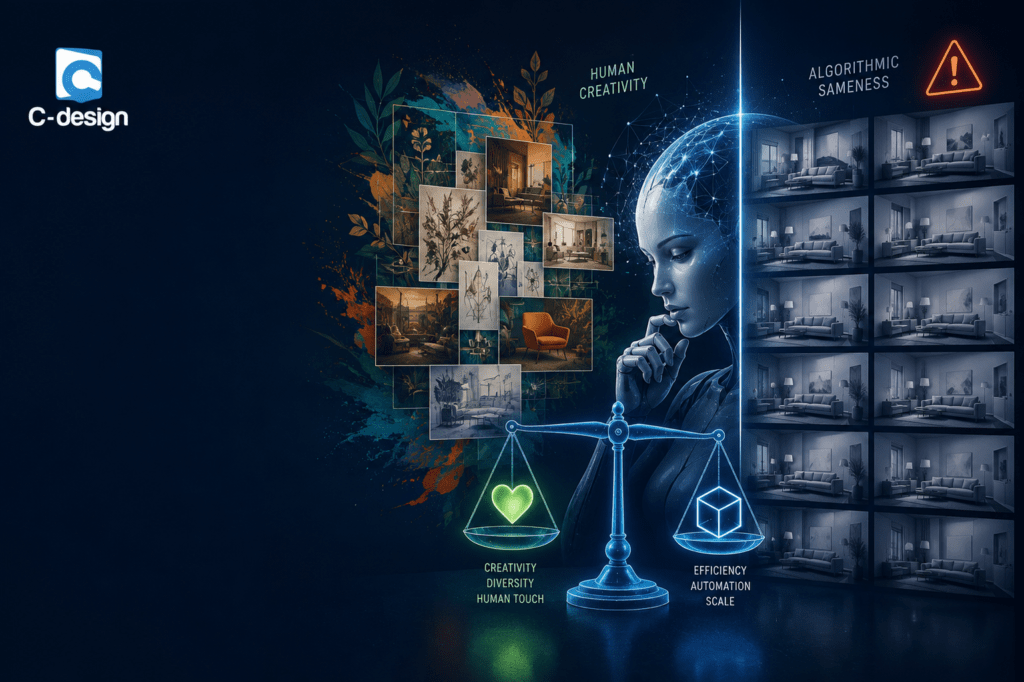
The Ethics of AI Aesthetics: Avoiding the Trap of "Algorithmic Sameness" in Modern Design

THE ETHICS OF AI AESTHETICS Avoiding the Trap of “Algorithmic Sameness” in Modern Design

By Outsourcing CAD Works  |  www.outsourcingcadworks.com

Artificial intelligence is changing how we design buildings, products, interiors, and brands. AI tools can generate endless variations, suggest layouts, and even create photorealistic visuals in seconds. But as AI becomes more common, a new concern is emerging: the risk of "algorithmic sameness."

Algorithmic sameness happens when AI tools produce designs that feel similar, predictable, or overly optimized. When many designers use the same AI systems trained on the same datasets, outputs can start to look and feel alike. That is not just a creative problem. It is also an ethical one.

For design firms, studios, and architects, this raises important questions. How do we use AI responsibly? How do we keep human creativity at the center? And how can we avoid letting AI shape our aesthetics more than we intend?

This is where Outsourcing CAD Works can play a valuable role. By combining AI-assisted workflows with human-led CAD support, design teams can preserve originality, maintain ethical standards, and deliver more distinctive results.

What Is Algorithmic Sameness?

Algorithmic sameness describes a pattern where AI-generated designs start to converge toward similar styles, layouts, or visual languages. This happens because AI models learn from existing data. If that data is biased toward certain styles, trends, or popular solutions, the AI will tend to reproduce them.

In practice, this might mean:

  • Interiors that share the same color palettes and furniture arrangements.
  • Building facades that follow similar patterns.
  • Product forms that look too familiar.
  • Brand identities that feel generic.

On the surface, this may not seem harmful. But when AI shapes aesthetics too strongly, it can reduce diversity, suppress local culture, and make design feel less human.

Why It Is an Ethical Issue

The ethics of AI aesthetics go beyond aesthetics themselves. They touch on responsibility, originality, cultural sensitivity, and the role of the designer.

When AI systems influence design decisions, there are several ethical concerns:

  • Loss of originality: If many designers rely on the same AI tools, innovation can stall.
  • Cultural bias: AI trained on limited datasets may favor certain styles while ignoring others.
  • Authorship confusion: It becomes unclear who is responsible for the final design.
  • Client transparency: Clients may not know how much of the design was AI-generated.
  • Professional accountability: Designers must ensure AI outputs meet safety, function, and quality standards.

These are not just technical issues. They shape how we practice design and how we serve clients and communities.

The Value of Human Judgment

AI is powerful, but it does not replace human judgment. Designers bring context, empathy, ethics, and creativity that AI cannot replicate. A human designer understands cultural nuance, client identity, and the emotional impact of space and form.

That is why human judgment must remain central. AI can suggest options, but designers should decide what is appropriate, meaningful, and responsible. This balance is essential to avoid algorithmic sameness.

When designers treat AI as a collaborator rather than a decision-maker, they preserve the integrity of their work. They can use AI to explore ideas faster while still steering the creative direction.


How Outsourcing CAD Works Supports Ethical AI Use

This is where Outsourcing CAD Works becomes especially useful. Ethical AI use requires structure, oversight, and human review. Outsourced CAD teams can help ensure that AI-generated ideas are translated into accurate, well-documented, and production-ready designs.

Outsourcing CAD support can help by:

  • Preparing clean, accurate base drawings for AI workflows.
  • Refining AI-generated concepts into buildable solutions.
  • Ensuring documentation meets professional standards.
  • Supporting revisions and quality checks.
  • Reducing the risk of relying solely on automated outputs.

By combining AI with expert CAD support, design firms can maintain control over quality and originality while still benefiting from AI speed.

Practical Ways to Avoid Algorithmic Sameness

Designers and studios can take practical steps to keep their work distinctive and ethically sound.

  • Diversify AI inputs: Use multiple tools and datasets to avoid over-reliance on one system.
  • Edit and refine AI outputs: Treat AI results as starting points, not final answers.
  • Maintain human oversight: Always review AI suggestions through a human lens.
  • Prioritize local context: Consider culture, climate, and community in design decisions.
  • Document AI usage: Be transparent with clients about how AI was used.
  • Use CAD support to ground ideas: Turn AI concepts into precise, production-ready documentation.

These practices help designers stay creative while using AI responsibly.

The Role of Transparency and Accountability

Transparency is a key part of ethical AI use. Clients and stakeholders should understand how AI fits into the design process. This builds trust and ensures everyone knows where human judgment is applied.

Accountability is equally important. Designers must take responsibility for the final outcome, even if AI contributed to the process. That means reviewing outputs, checking for bias or errors, and ensuring the design meets all requirements.

When transparency and accountability are built into the workflow, AI becomes a tool for empowerment rather than a source of risk.

The Root Causes of Algorithmic Sameness

  • Overlapping training datasets: Most generative AI design tools are trained on similar publicly available design libraries, so their “creative range” naturally converges.

  • Default settings and templates: Many CAD and rendering tools ship with default parameters that most users never customize, producing near-identical outputs across projects.

  • Speed-first workflows: Under tight deadlines, teams often accept the first AI-generated option instead of iterating toward something distinctive.

  • Lack of domain-specific fine-tuning: Generic AI models aren't tuned for a client's brand, region, or engineering constraints, so they default to the statistical “middle.”

  • Absence of skilled human review: Without experienced designers and engineers refining AI output, sameness goes unchallenged and unnoticed.

How to Avoid the Trap: Principles for Ethical AI-Assisted Design

The good news is that algorithmic sameness is not an inevitable side effect of using AI — it's a management problem, and it's solvable. Here's how forward-thinking design and CAD teams are addressing it.

Treat AI as a Collaborator, Not a Decision-Maker

AI tools are extraordinary at generating options, running iterations, and handling repetitive drafting work. But the final creative and engineering decisions should always rest with a human expert who understands the client's brand, the site context, the manufacturing process, and the end-user's needs.

Curate and Localize Training Inputs

Where possible, design teams should fine-tune or guide AI tools using region-specific, brand-specific, or project-specific references rather than relying on generic global datasets. This keeps outputs relevant to local culture, codes, and client identity instead of defaulting to a generic global style.

Build in Deliberate Human Review Checkpoints

Every AI-assisted deliverable — a 3D model, a rendering, a structural layout — should pass through experienced human reviewers who check for originality, manufacturability, code compliance, and brand fit before it reaches the client.

Diversify Your Toolset and Talent Pool

Relying on a single AI platform, and a single, narrow in-house team, increases the risk of repetitive outputs. Partnering with a broader, more diverse pool of engineers and designers introduces varied perspectives that counteract algorithmic convergence.

Preserve the Human Signature

Great design has always carried a human signature — an engineer's judgment call, a designer's instinct for proportion, a drafter's understanding of how a part will actually be assembled. Ethical AI adoption protects space for that signature instead of erasing it.

How Outsourcing CAD Works Helps You Design Ethically — Without Sacrificing Speed

At Outsourcing CAD Works, we believe AI should accelerate human creativity, not replace it. Our approach to CAD design, drafting, BIM modeling, 3D rendering, and engineering documentation is built around a simple philosophy: let automation handle the repetitive heavy lifting, and let experienced human engineers and designers protect the originality, accuracy, and intent of every project.

Here's how that philosophy translates into real advantages for our clients:

1. Human-Led Review on Every AI-Assisted Deliverable

Every CAD drawing, 3D model, or rendering that passes through our studio is reviewed by qualified engineers and designers before delivery. We use AI and automation to speed up drafting, clash detection, and iteration — but the creative and technical judgment behind every final file is unmistakably human.

2. A Global, Diverse Team of Design Specialists

Outsourcing CAD Works draws on a diverse bench of architectural drafters, mechanical designers, structural engineers, and BIM specialists. This diversity of background and experience is a natural antidote to algorithmic sameness: your project benefits from varied design instincts, not a single automated default.

3. Custom, Project-Specific Design Standards

Instead of pushing every client toward a generic, one-size-fits-all output, we tailor our CAD standards, templates, and design language to each client's brand, region, building codes, and industry requirements — ensuring your projects stay distinctive rather than interchangeable.

4. Faster Turnarounds Without Cutting Ethical Corners

Outsourcing your CAD, drafting, and modeling work to our team means you get the speed and cost efficiency of automation-assisted workflows, combined with the accountability of a dedicated human team that stands behind every deliverable, every tolerance, and every design decision.

5. Strict Accountability and Quality Control

We maintain clear, documented QA checkpoints across every project stage — concept, modeling, detailing, and final review — so there is always a responsible, qualified professional accountable for the design, not just an algorithm.

6. Cost-Effective Access to Senior Design Talent

By outsourcing to Outsourcing CAD Works, architecture firms, engineering companies, and manufacturers get access to senior-level CAD, BIM, and 3D modeling expertise at a fraction of the cost of building an in-house team — without sacrificing the originality and rigor that ethical design demands.

Why This Matters for Design Firms

For design firms, avoiding algorithmic sameness is not only about ethics. It is also about business value. Distinctive, original work attracts better clients, commands higher fees, and builds stronger reputations.

If a firm's work starts to look like everyone else's, it loses competitive advantage. That is why investing in human creativity, ethical AI use, and quality CAD support is so important.

Firms that balance AI efficiency with human originality will stand out in a crowded market. They will be seen as thoughtful, innovative, and trustworthy.

How Outsourcing CAD Works Adds Value

Outsourcing CAD Works helps design teams maintain quality and control while using AI tools. Whether the project is architectural, interior, product, or brand-related, outsourced CAD support ensures that designs are accurate, consistent, and ready for execution.

This support is especially valuable when AI is involved. It allows designers to experiment with AI-generated ideas while keeping the technical side of the work in expert hands. That balance makes it easier to avoid the trap of algorithmic sameness.

Real-World Benefits for Designers

When designers use AI ethically and combine it with strong CAD workflows, they gain several benefits:

  • Faster concept development.
  • More time for creative thinking.
  • Better control over quality.
  • Stronger client communication.
  • Reduced risk of generic outputs.
  • More distinctive design identity.

These advantages help firms deliver better work while staying true to their values.

The Future of Ethical AI in Design

The future of design will likely involve more AI, not less. That is why establishing ethical practices now is so important. As tools evolve, designers must remain intentional about how they use them.

Ethical AI use does not mean avoiding AI. It means using AI with awareness, responsibility, and human oversight. It means treating AI as a partner in the creative process rather than a replacement for it.

For firms that want to grow without losing their identity, this approach is essential.


Why Outsourcing CAD Works Is a Strong Partner

Outsourcing CAD Works supports design teams with accurate, reliable CAD production so they can focus on creative direction and ethical decision-making. Whether the need is for drafting, 3D modeling, documentation, or revision support, outsourcing gives teams the flexibility to work smarter.

That matters in a market where clients expect speed, originality, and quality. By reducing the load on internal staff, firms can respond faster, maintain higher standards, and deliver more distinctive results.

The Future: AI as an Amplifier of Human Creativity

The ethical path forward isn't to reject AI in design and engineering — that ship has sailed, and the productivity gains are too significant to ignore. The real challenge is building workflows, teams, and quality-control systems that use AI to amplify human creativity rather than replace it. Firms that get this balance right will produce work that is both fast to deliver and genuinely distinctive; firms that don't will blend into an ocean of interchangeable, algorithm-average design.

At Outsourcing CAD Works, this balance is not an afterthought — it's the core of how we operate. Whether you need architectural CAD drafting, mechanical design, BIM modeling, 3D rendering, or full-scale engineering documentation, our team combines the efficiency of modern tools with the accountability and originality of experienced human professionals.

SEO Keywords

AI ethics in design, algorithmic sameness, AI aesthetics, ethical AI use, outsourcing CAD works, CAD outsourcing, design originality, AI in architecture, AI in interior design, design documentation, AI-generated design, human-centered design, responsible AI.

FAQs

1. What does “algorithmic sameness” mean in AI-driven design?

It refers to the growing visual and structural similarity among designs created with AI tools, caused by generative models being trained on overlapping datasets and defaulting to statistically “safe,” popular patterns rather than original ones.

2. Is using AI in CAD design and architecture unethical?

No — AI itself is a neutral tool. The ethical concern arises when AI outputs are used without human review, local context, or accountability, leading to homogenized, potentially unsafe, or culturally disconnected designs.

3. How can I tell if my design team is over-relying on AI?

Warning signs include accepting the first AI-generated option without iteration, using generic templates across all clients, skipping human QA on AI-assisted drawings, and producing designs that feel interchangeable with competitors' work.

4. Does outsourcing CAD work make algorithmic sameness worse?

Not when done correctly. Outsourcing to a partner like Outsourcing CAD Works actually helps combat sameness by adding diverse, experienced human designers and structured review processes on top of any AI-assisted tools used in the workflow.

5. What industries are most affected by AI aesthetic homogenization?

Architecture, interior design, product design, and industrial/mechanical design are currently the most affected, since generative AI tools are widely used for concept generation, rendering, and rapid prototyping in these fields.

6. How does Outsourcing CAD Works ensure design originality?

Every AI-assisted deliverable goes through human-led review by qualified engineers and designers, uses project-specific standards instead of generic templates, and draws on a diverse global team to introduce varied design perspectives.

7. Can AI and human designers really work together effectively?

Yes. The most successful modern design workflows use AI for speed — drafting, iteration, clash detection — while human designers and engineers retain control over creative direction, cultural context, and final technical accuracy.

Ready to Design Smarter — Without Losing Your Originality?

At Outsourcing CAD Works, we help architecture firms, engineering companies, and manufacturers get the speed and cost savings of AI-assisted CAD workflows, backed by the judgment, accountability, and originality of a skilled human team. If you're ready to break free from algorithmic sameness and deliver design work that truly stands out, let's talk.

👉 Visit us at www.outsourcingcadworks.com to explore our CAD drafting, BIM modeling, 3D rendering, and engineering design services, or reach out today for a free project consultation.

Call to Action

If you want to use AI responsibly while keeping your designs original and high-quality, now is the time to build a smarter workflow. Outsourcing CAD Works helps design teams combine AI efficiency with expert CAD support so they can focus on creativity and ethical decision-making.

Whether you need drafting, 3D modeling, or documentation support, our team is ready to help. Visit www.outsourcingcadworks.com to learn more and see how we can support your design projects.

Tags

AI Ethics, Algorithmic Sameness, AI Aesthetics, Ethical AI Use, CAD Outsourcing, Outsourcing CAD Works, Design Originality, AI in Architecture, AI in Interior Design, Design Documentation, AI-Generated Design, Human-Centered Design, Responsible AI

Wednesday, 5 August 2026

The Symbiotic Relationship of AI and Interior Design

 The Symbiotic Relationship of AI and Interior Design

How artificial intelligence is reshaping interior design workflows, and why pairing AI tools with expert outsourced CAD and 3D design support delivers the best results for designers and clients alike.

By Outsourcing CAD Works  |  www.outsourcingcadworks.com

Artificial intelligence is no longer a futuristic idea in interior design. It is already changing the way designers plan spaces, build concepts, create presentations, and respond to client expectations. But the real story is not about AI replacing interior designers. It is about a symbiotic relationship where human creativity and machine intelligence work together to produce better, faster, and more personalized results.

For interior designers, architects, and design studios, this shift matters. AI can help speed up repetitive tasks, improve visualization, and support smarter decision-making. Human designers still bring the emotional intelligence, aesthetic judgment, and client understanding that software cannot replicate. When both work together, the result is a more efficient and more inspired design process.

For firms that want to stay competitive, Outsourcing CAD Works offers an important advantage. By combining outsourced CAD support with AI-assisted workflows, interior design businesses can scale faster, deliver cleaner documentation, and focus more time on creative direction and client service.


What Does Symbiotic Mean in Interior Design?

A symbiotic relationship means two different forces support each other in a way that benefits both. In interior design, that means AI and human designers are not competing for the same role. Instead, each one strengthens the other.

AI is excellent at processing data, spotting patterns, generating design alternatives, and automating routine work. Interior designers are excellent at interpreting client needs, balancing aesthetics with function, and creating spaces that feel personal and practical. Together, they create a workflow that is both efficient and human.

This relationship is especially valuable in modern design projects where clients expect faster turnaround, more visual clarity, and more confident decision-making.


How AI Supports Interior Designers

AI tools are already being used across the interior design workflow. They can analyze room dimensions, suggest layout ideas, generate mood boards, recommend color palettes, and produce photorealistic renderings. Some tools can even restyle a room from a simple photo or sketch.

This support saves time in the early design stages. Instead of starting from scratch every time, designers can use AI to generate possibilities, then refine the best ideas manually. That means less time spent on repetitive tasks and more time spent on creative problem-solving.

AI can also help with space planning, furniture selection, lighting studies, and client presentations. In many cases, it makes the design process feel faster and more collaborative.

Why Human Creativity Still Matters

Even the best AI tools cannot replace the human side of design. Interior design is not only about arranging furniture or choosing finishes. It is about understanding how people live, work, relax, and move through a space.

A human designer can interpret emotional tone, cultural preference, budget limitations, and lifestyle needs in ways AI cannot fully grasp. A family home, a boutique office, and a luxury hospitality project all require different kinds of sensitivity and decision-making.

That is why AI works best as a partner, not a replacement. It handles the technical and repetitive side of the work while designers focus on meaning, storytelling, and the client experience.

Faster Concept Development and Visualization

One of the biggest benefits of AI in interior design is faster concept development. Traditionally, it could take a designer hours or even days to develop initial concepts, create layout options, and prepare presentation visuals. AI reduces that time dramatically.

With AI-assisted workflows, designers can quickly test multiple ideas, compare styles, and show clients a wider range of options. This helps projects move forward faster and reduces back-and-forth during the early stages.

Visualization also becomes more powerful. AI-generated renderings and realistic previews help clients understand what the final space may look like before work begins. That leads to better communication, fewer misunderstandings, and stronger design approvals.

The Role of Outsourcing CAD Works

This is where Outsourcing CAD Works becomes especially useful. Interior design projects often require detailed CAD drawings, floor plans, elevations, sections, furniture layouts, and construction-ready documentation. These tasks are essential, but they can also consume a huge amount of time.

By outsourcing CAD production, designers can free up internal time for creative and client-facing work. Outsourced CAD support can help with:

Accurate drafting and documentation.

Floor plan updates.

Furniture and millwork drawings.

Interior elevations and sections.

Revision management.

3D modeling support for presentations and approvals.

When paired with AI tools, this becomes even more powerful. AI can assist with inspiration and visualization, while outsourced CAD teams turn concepts into organized, production-ready documentation.

Better Efficiency Without Losing Quality

A common concern with AI is that speed might come at the cost of quality. In interior design, that does not have to be the case. The best workflows use AI to accelerate the process while keeping the designer in control.

For example, AI might generate several layout ideas for a living room renovation. The designer then selects the strongest option, adjusts proportions, checks circulation, and refines the details based on real-world constraints. Meanwhile, CAD specialists ensure the drawings are accurate, clean, and ready for execution.

This balance helps firms maintain quality while improving productivity. It is a practical way to take on more projects without overloading the team.

AI and Client Communication

Interior design is a highly visual and highly personal service. Clients often struggle to interpret flat drawings, but they respond quickly to strong visuals. AI helps bridge that gap.

With AI-generated renders, room mockups, and design variations, clients can see how a concept will look and feel much earlier in the process. That makes it easier to get feedback, secure approval, and move forward with confidence.

This also improves the client experience. Instead of waiting for a final reveal, clients can engage with the design journey from the beginning. That sense of involvement builds trust and reduces costly revisions later.

Real Benefits for Design Firms

For interior design firms, the AI-plus-human model creates clear business advantages.

Faster project turnaround.

More concept options in less time.

Better client communication.

Stronger presentation quality.

Reduced drafting workload.

More room for creative focus.

Easier scalability during busy periods.

These are not just workflow benefits. They also affect profitability. When your team spends less time on repetitive production work, you can take on more work, improve margins, and deliver a better overall service.

Why Outsourcing CAD Helps AI Workflows

AI tools are powerful, but they still need structured input and professional oversight. Poorly prepared drawings, missing dimensions, and inconsistent model data can limit the value of AI. That is why outsourcing CAD support can be a smart move.

A skilled outsourced team can prepare accurate plans, maintain drawing consistency, and support revisions quickly. This means the design team gets reliable documentation that AI tools can use more effectively.

For firms working at scale, this creates a strong foundation. AI handles inspiration and acceleration. Outsourced CAD handles precision and production. The design team handles creativity and decision-making. Together, the workflow becomes smoother and more resilient.

Common Ways AI Is Used in Interior Design AI is being used in many practical ways across the interior design industry.

Generating mood boards and style directions.

Creating initial layout concepts.

Suggesting color palettes and finishes.

Producing photorealistic visualizations.

Restyling rooms from photos.

Supporting virtual staging.

Speeding up presentation development.

Helping designers explore more options quickly.

These uses make AI especially valuable in early-stage design and client communication, where speed and clarity matter most.

How AI Is Transforming the Interior Design Process

1. AI-Powered Space Planning

AI-driven space planning tools can analyze a floor plan and instantly generate multiple furniture layout options based on room dimensions, traffic flow, and functional requirements. What used to take hours of manual trial and error can now be explored in minutes, giving designers a strong starting point to refine and personalize.

2. Generative Design and Style Exploration

Generative AI tools can produce dozens of interior design concepts based on a simple text prompt or reference image — different color palettes, furniture arrangements, and material combinations — allowing designers to quickly explore creative directions before committing to detailed development.

3. Photorealistic AI Rendering

AI-enhanced rendering engines can now generate highly realistic visualizations of interior spaces in a fraction of the time traditional rendering software requires. This helps designers present concepts to clients faster, with lighting, textures, and materials that look remarkably close to the finished result.

4. Virtual Staging for Real Estate and Presentations

AI-powered virtual staging tools can furnish and decorate empty rooms digitally, helping real estate agents and designers showcase a space's potential without the cost of physical staging. This has become especially valuable for marketing listings and pitching design concepts.

5. Smart Material and Furniture Recommendations

AI algorithms can suggest materials, color schemes, and furniture pieces based on a client's style preferences, budget, and even sustainability goals, streamlining the sourcing process and reducing decision fatigue for both designers and clients.

6. Predictive Budgeting and Procurement

Some AI-driven platforms can estimate material and furnishing costs based on design selections, helping designers manage budgets more accurately and avoid costly surprises during procurement.

The Future of Interior Design


The future of interior design will likely be a blend of creativity, automation, and collaboration. AI will continue to get better at speeding up visual development and design analysis. Human designers will continue to provide the vision, intuition, and emotional understanding that make a space meaningful.

That is why the relationship is symbiotic. The more AI improves, the more it supports the designer’s process. The more designers embrace AI, the more productive and responsive they can become.

For agencies and studios that want to grow without compromising quality, combining AI tools with outsourced CAD support is a smart way to stay ahead.

How Outsourcing CAD Works Helps You Get the Best of AI and Human Expertise

At Outsourcing CAD Works, we help interior designers, architects, and design firms harness the power of AI while ensuring every deliverable is technically precise, production-ready, and true to the designer's creative vision.

1. Turning AI Concepts into Accurate CAD Drawings

AI tools are excellent for generating creative concepts, but converting those ideas into precise, buildable CAD drawings requires technical expertise. Our team translates AI-generated layouts and renderings into accurate 2D drafting and 3D models ready for construction and procurement.

2. High-Quality 3D Rendering and Visualization

While AI rendering tools offer speed, our experienced 3D visualization team refines those outputs with expert lighting, material accuracy, and photorealistic detail, ensuring your client presentations look polished, professional, and true to life.

3. BIM Integration for Interior Projects

We help designers integrate AI-assisted concepts into full BIM workflows, ensuring interior elements align accurately with architectural and MEP systems for seamless coordination across the entire project team.

4. Faster Project Turnaround

By combining AI-powered ideation with our efficient outsourced drafting and rendering teams, designers can move from concept to client-ready presentation significantly faster, helping firms take on more projects without sacrificing quality.

5. Cost-Effective Scalability

Outsourcing CAD Works offers flexible, scalable support so design studios of any size can access skilled drafting, rendering, and BIM professionals on demand, without the overhead of hiring and training an in-house technical team.

6. Quality Assurance and Technical Accuracy

Every AI-assisted design we work on goes through a human quality check to correct proportions, validate materials, and ensure the final output is not just visually appealing but technically sound and ready for real-world execution.

Best Practices for Using AI in Interior Design

  • Use AI tools for early-stage ideation and concept exploration, not final technical documentation.
  • Always validate AI-generated layouts against real-world dimensions and building codes.
  • Pair AI-generated renderings with professional visualization for client-facing presentations.
  • Maintain a consistent design language by guiding AI tools with clear style references and briefs.
  • Partner with experienced CAD and BIM professionals to convert creative concepts into accurate, buildable designs.

The Future of AI and Interior Design

As AI tools continue to evolve, we can expect even deeper integration between generative design, real-time rendering, and smart material databases. Future workflows may allow designers to adjust a room's layout, lighting, and materials in real time while instantly seeing accurate cost estimates and sustainability impacts.

However, the core truth will remain the same: AI is a powerful creative and technical accelerator, but the emotional intelligence, cultural sensitivity, and design judgment of skilled human professionals will continue to define truly exceptional interior spaces. The firms that thrive will be the ones who successfully blend both — and that is exactly the kind of partnership Outsourcing CAD Works is built to support.

Why Outsourcing CAD Works Is a Strong Partner

Outsourcing CAD Works helps interior design professionals manage the technical side of projects with greater ease. Whether the need is for drafting support, 3D modeling, drawing production, or design documentation, outsourcing gives teams the flexibility to deliver faster while staying focused on what they do best.

That matters in a market where clients expect speed, polish, and accuracy. By reducing the load on internal staff, companies can respond faster to inquiries, handle more projects, and improve consistency across deliverables.

Ready to Blend AI Creativity with Technical Precision?

If you want to harness the speed of AI-driven interior design while ensuring every drawing, rendering, and model is technically accurate and client-ready, it's time to partner with a team that understands both worlds.

Get in touch with Outsourcing CAD Works today for expert CAD drafting, 3D rendering, and BIM services that bring your AI-assisted interior design concepts to life.

Visit us at www.outsourcingcadworks.com to request a free quote or consultation.

Keywords

AI interior design, interior design automation, CAD outsourcing, outsourcing CAD works, AI design tools, interior design visualization, 3D rendering for interiors, space planning AI, interior design documentation, design workflow automation, interior design services, photorealistic renderings.

FAQs

  1. What is the role of AI in interior design?
    AI helps interior designers generate ideas, visualize spaces, speed up repetitive tasks, and improve presentation quality while still leaving creative decisions to the human designer.

  2. Will AI replace interior designers?
    No. AI is more likely to support interior designers by automating routine work and improving efficiency. Human judgment and creativity remain essential.

  3. How does AI improve interior design workflows?
    AI can help with mood boards, layout ideas, renderings, style recommendations, and faster visualization, making the design process more efficient.

  4. Why is outsourcing CAD useful for interior design firms?
    Outsourcing CAD helps firms manage drafting, documentation, and 3D support without overloading internal teams, allowing designers to focus more on creativity and clients.

  5. Can AI help with client presentations?
    Yes. AI-generated visuals and room mockups help clients better understand concepts, which can improve approvals and reduce revisions.

  6. How does Outsourcing CAD Works support interior design?
    Outsourcing CAD Works provides design support such as drafting, 3D modeling, and documentation, helping interior design businesses work faster and more efficiently.

  7. Is AI useful for small interior design studios?
    Absolutely. Small studios can use AI to save time, produce stronger visuals, and compete more effectively while outsourcing production work when needed.

Call to Action


If you want to design smarter, move faster, and deliver better results to clients, now is the time to combine AI with expert CAD support. Outsourcing CAD Works helps interior design teams streamline documentation, improve visualization workflows, and scale their projects with confidence.

Whether you need CAD drafting, 3D modeling, or support for AI-assisted design workflows, our team is ready to help. Visit www.outsourcingcadworks.com to learn more and see how we can support your interior design projects.

Tags

AI Interior Design, Interior Design Automation, CAD Outsourcing, Outsourcing CAD Works, 3D Rendering, Space Planning, Interior Design Visualization, Design Documentation, AI Tools for Designers, Interior Design Workflow, Photorealistic Renderings, Design Studio Support