What Makes C-Design a Trusted Partner for Architectural Drafting Services Worldwide?
Introduction: The Global Challenge of Scaling Architectural Drafting
Imagine you are an architectural firm based in New York, London, or Sydney. Your pipeline is full — a retail chain needs 40 new store layouts drawn up, a hospitality group wants complete Revit documentation for 15 hotel renovations, and a commercial developer is pressing for MEP drafting across an entire office complex. Your in-house team is already stretched thin. Hiring more staff takes months. Project deadlines wait for no one.
This is the defining pain point for architectural firms, interior designers, retail planners, and construction companies worldwide: the pressure of launching large product lines and managing high-volume drafting workloads with limited internal capacity.

The answer that thousands of professionals across the US, UK, Germany, France, Australia, New Zealand, and beyond have discovered is strategic outsourcing — specifically, partnering with Outsourcing CAD Works, powered by C-Design.
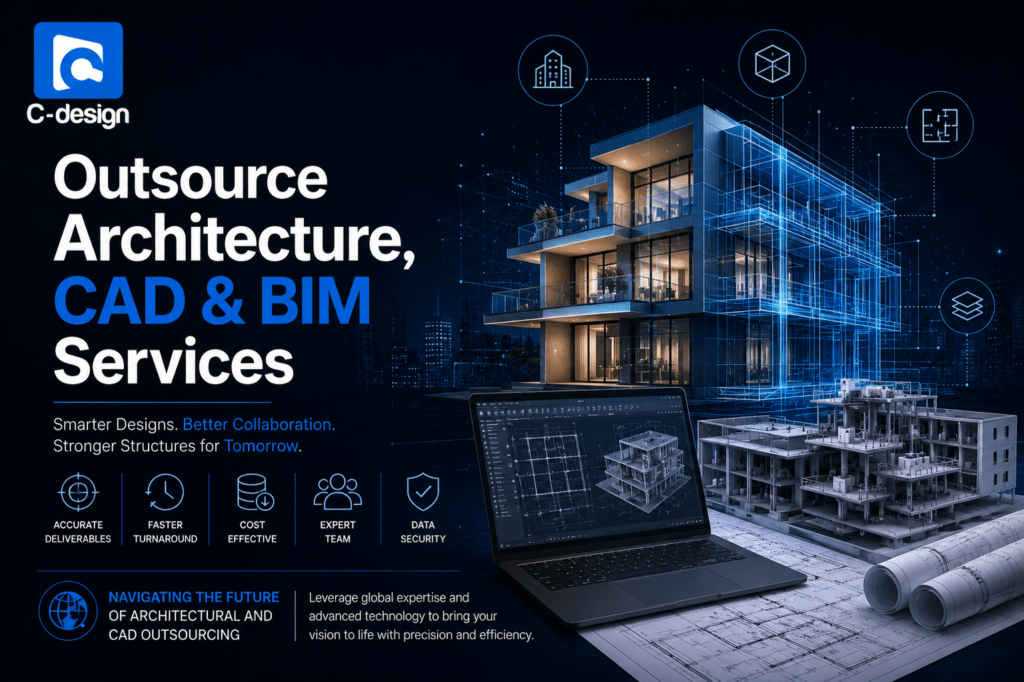
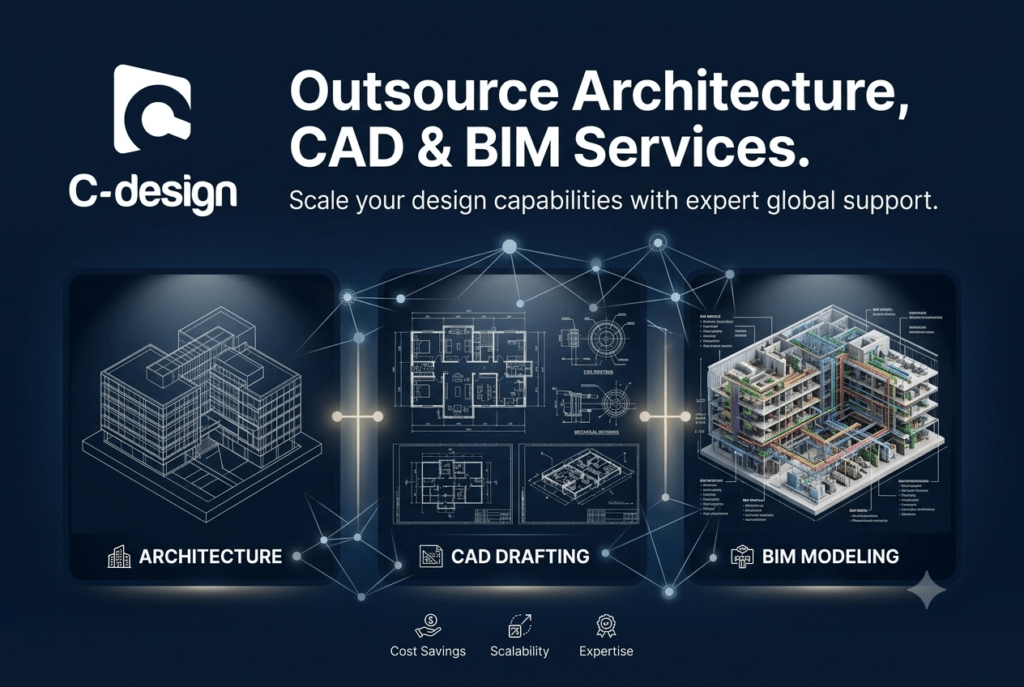
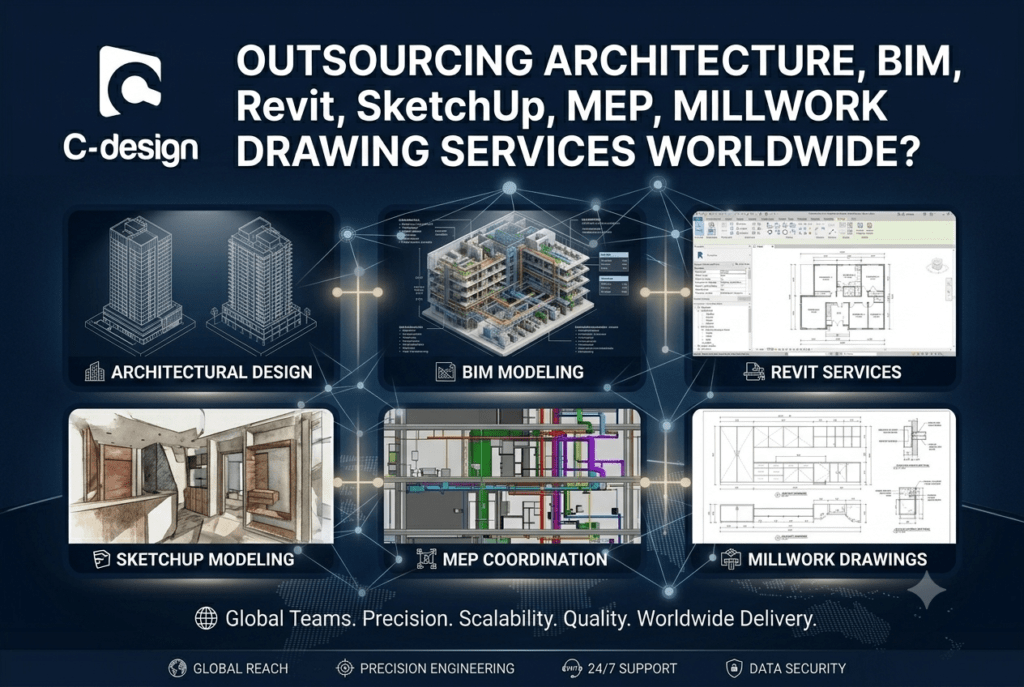
With over 20 years of experience, a team of 300+ professionals, and a portfolio of 500+ delivered projects for 140+ satisfied clients globally, Outsourcing CAD Works (OCW) has established itself as the go-to partner for Outsourcing Architectural Services, CAD Outsourcing, BIM Services, Revit Services, SketchUp Modeling, Millwork Drawings, Architecture Renderings, MEP Drafting, Store-Retail Planning, and Hospitality Design Drafting.
This blog dives deep into why C-Design's Outsourcing CAD Works is the top choice for architectural drafting outsourcing worldwide, and how it solves the real-world challenges that firms face when scaling their operations.
| 20+Years Experience | 300+Professionals | 500+Projects Delivered | 140+Satisfied Clients |
1. The Pain Point: Launching Large Product Lines in Architecture & Design
Whether you are a global retailer rolling out 50 new store formats, a hospitality brand expanding into new markets, or an architectural firm managing multi-site commercial projects, the challenge is always the same: scale.
The traditional model of keeping all drafting work in-house simply cannot keep pace with the ambitions of fast-growing businesses. Here is why:
- Hiring and training CAD/BIM professionals is slow and expensive
- Peak workloads are unpredictable — teams are overstretched during high demand and underutilised during quiet periods
- Delivering consistent quality across dozens or hundreds of drawings simultaneously is nearly impossible with small teams
- Time zone differences make coordination between international teams a logistical challenge
- Software licences for Revit, AutoCAD, SketchUp, and other platforms add significant overhead costs
This is precisely where Outsourcing CAD Services through a trusted partner like OCW transforms the business model. Rather than struggling with internal limitations, global brands can tap into a ready-deployed, highly skilled team that operates as a seamless extension of their own workforce.
2. What Is Outsourcing CAD Works? A Brief Introduction to C-Design
Outsourcing CAD Works is the outsourcing division of C-Design Pvt Ltd, a company with more than two decades of deep expertise in architectural, engineering, and BIM services. Based in India with a UAE presence, C-Design serves clients across the US, UK, Europe, Australia, New Zealand, and the Middle East — delivering high-precision architectural and CAD drafting solutions at globally competitive rates.
OCW's service philosophy is simple: act as an extended arm of your client's team. They do not just deliver drawings; they integrate into client workflows, adopt client standards and templates, and ensure every deliverable is ready for immediate use — whether it is a set of Millwork Drawings for a luxury furniture brand or a full Revit Documentation package for a commercial developer.
Their capabilities span the entire architectural lifecycle:
- CAD Outsourcing (AutoCAD 2D drawings, construction documentation, as-built drawings)
- BIM Services (Revit modeling, LOD-based BIM, clash detection, BIM coordination)
- Revit Services (Revit modeling, documentation, family creation, estimation)
- SketchUp Modeling (interiors, retail spaces, urban models, terrain and landscape)
- Architecture Renderings (photorealistic still images, walkthroughs, panoramas, VR/AR)
- MEP Drafting (mechanical, electrical, and plumbing drawing sets)
- Millwork Drawings (detailed shop drawings for joinery, furniture, and fit-outs)
- Store-Retail Planning (retail space planning, store planning and documentation)
- Hospitality Design Drafting (hotels, restaurants, resorts — full drafting and documentation)
3. The Massive Advantage: Team Capacity That Scales with Your Business
One of the most compelling differentiators of Outsourcing CAD Works is its sheer team capacity. With 300+ seasoned professionals ready to deploy, OCW can mobilise resources for any project scale — from a single drawing revision to a full-scale product line launch involving hundreds of drawings across multiple site types.
For global brands and architectural firms, this capacity translates into tangible business advantages:
A. Rapid Scale-Up Without Recruitment Overhead
When a retail client needs 60 store fit-out drawings completed in 30 days, OCW can assign a dedicated team immediately. There is no need to post job advertisements, conduct interviews, onboard new employees, or purchase additional software licences. The team is already trained, equipped, and ready to work within the client's standards.
B. Consistent Quality Across High Volumes
Delivering 10 consistent drawings is easy. Delivering 300 consistent drawings to the same standard, across the same template, with the same level of accuracy — that requires systems, processes, and experienced leadership. OCW's structured workflow management and quality-check protocols ensure that every drawing in a large batch meets the same high standard as the first.
C. Parallel Workstreams for Faster Delivery
With a large team, OCW can run multiple workstreams simultaneously. While one group handles Revit modeling for a hotel project, another is completing retail space planning for a supermarket chain, and a third is producing architecture renderings for a developer's marketing campaign. This parallel capacity dramatically compresses project timelines.
D. Time Zone Advantage — 24-Hour Productivity
C-Design's India base means that while clients in the US, UK, Germany, France, Australia, or New Zealand are finishing their working day, OCW's team is ready to begin. This creates a near-continuous production cycle, meaning project deliverables are ready and waiting when clients return to their desks each morning.
4. Why Outsourcing Architectural Services Makes Smart Business Sense
Beyond capacity, the business case for Outsourcing Architectural Services is compelling for firms of every size — from boutique studios to multinational architecture and design companies.
Cost Efficiency Without Compromising Quality
Hiring experienced CAD/BIM professionals in the US, UK, Germany, France, Australia, or New Zealand is expensive. Salaries, benefits, office space, and software licences create a significant overhead. By partnering with Outsourcing CAD Works, firms access the same level of expertise — often higher, given OCW's specialisation — at a fraction of the cost. These savings can be reinvested into business development, design innovation, or client acquisition.
Focus on Core Competencies
When your architects and designers are not buried in repetitive drafting tasks, they are free to do what they do best: design, innovate, consult, and grow client relationships. CAD Outsourcing allows your senior team to focus on high-value creative and strategic work while OCW handles the technical production.
Flexibility to Respond to Market Demand
Architectural work is inherently cyclical. Project volumes fluctuate based on economic conditions, client pipelines, and seasonal factors. With Outsourcing CAD Services, firms can scale their drafting capacity up or down based on real-time demand — without the HR complexity of hiring and redundancy.
Access to Specialised Expertise
Not every in-house team has deep expertise in every discipline. OCW gives firms instant access to specialists in BIM Services, MEP Drafting, Hospitality Design Drafting, Millwork Drawings, SketchUp Modeling, and high-quality Architecture Renderings — disciplines that may be outside the core skill set of a generalist studio.
Global Compliance and Standards
OCW's teams are experienced in working to international drawing standards, including those used in the US, UK, Australia, and European markets. They adapt to client-specific templates, layer standards, and naming conventions, ensuring that outsourced drawings integrate seamlessly into the client's existing documentation sets.
5. C-Design's Core Services: A Deep Dive
BIM Services
Building Information Modelling is no longer optional for serious architectural and construction firms. OCW's BIM Services team delivers LOD 100 through LOD 500 Revit models, fully coordinated and clash-detected, ready for construction. Whether clients need BIM for design coordination, client presentations, or contractor handover, OCW's team delivers models that work in the real world.
Revit Services
Revit is the industry standard for building documentation, and OCW's Revit Services team is one of the most experienced outsourced Revit teams globally. Services include Revit modeling from scratch, Revit documentation and CD sets, Revit family creation, point cloud to Revit conversion, and Revit estimation. For firms launching large-scale Revit projects, OCW provides both the manpower and the expertise to deliver fast and accurately.
SketchUp Modeling
SketchUp remains a favourite tool for architects, interior designers, and retail planners for its versatility and speed. OCW's SketchUp Modeling team covers everything from interior SketchUp models to large-scale urban models, terrain and landscape models, exhibition and retail space models, and conversion of point cloud, Matterport, and PDF data into SketchUp files.
Architecture Renderings
In today's competitive real estate and design market, high-quality Architecture Renderings are essential for winning clients, securing planning approvals, and driving marketing campaigns. OCW's rendering team uses industry-leading tools including 3ds Max, V-Ray, Lumion, Twinmotion, and Vantage to deliver photorealistic still images, animated walkthroughs, 360-degree panoramas, and interactive AR/VR experiences.
MEP Drafting
Mechanical, Electrical, and Plumbing (MEP) drawings are critical for construction coordination and building compliance. OCW's MEP Drafting team produces accurate, coordinated MEP drawing sets that meet the standards required by building authorities in the US, UK, Australia, and beyond. With deep knowledge of MEP systems, the team ensures that drawings support seamless contractor coordination and regulatory approval.
Millwork Drawings
For furniture manufacturers, fit-out contractors, and luxury interior designers, precision Millwork Drawings are essential. OCW produces detailed shop drawings for joinery, cabinetry, built-in furniture, and bespoke millwork elements. These drawings include all the detail required for fabrication — dimensions, materials, finishes, hardware, and assembly instructions — ensuring that what is designed is what gets built.
Store-Retail Planning
Retail brands expanding across new markets need accurate, standards-compliant Store-Retail Planning documentation. OCW works with global retail chains, franchise operators, and brand designers to produce complete store planning drawing sets — including floor plans, fixture layouts, reflected ceiling plans, and fit-out documentation. For brands launching multiple store formats simultaneously, OCW's team capacity is unmatched.
Hospitality Design Drafting
From boutique hotels to international resort chains, Hospitality Design Drafting requires a blend of architectural precision and design sensitivity. OCW's hospitality team has extensive experience delivering drafting and documentation services for hotels, restaurants, spas, resorts, and leisure facilities. Whether it is a single hotel renovation or a multi-property rollout, OCW provides the drafting support to bring hospitality visions to life.
6. Why Outsourcing CAD Works Is the Top Choice Globally
With numerous CAD outsourcing options available worldwide, what specifically makes Outsourcing CAD Works the preferred partner for clients in the US, UK, Germany, France, Australia, and New Zealand?
20+ Years of Proven Experience
Experience matters enormously in technical disciplines. OCW's two-decade track record means that processes, quality systems, client management protocols, and technical expertise are all refined and mature. Clients benefit from a partner that has seen every type of project challenge and knows how to handle it.
A Team of 300+ Skilled Professionals
Scale and expertise go hand in hand. OCW's 300+ professionals include dedicated CAD drafters, Revit specialists, BIM coordinators, SketchUp modelers, rendering artists, MEP engineers, millwork drafters, and project managers. This breadth ensures that every service is delivered by a genuine specialist, not a generalist attempting to cover multiple disciplines.
Seamless Workflow Integration
OCW does not operate as a disconnected vendor — they function as a true extension of the client's team. They adopt client standards, work within client project management systems, use client naming conventions and templates, and communicate in client time zones. The result is a collaboration that feels internal, with the efficiency and cost advantages of an external partner.
Multi-Software Expertise
Architecture and design firms use a range of software platforms depending on project type and client requirements. OCW's team is proficient across AutoCAD, Revit, SketchUp, 3ds Max, Lumion, Twinmotion, Vantage, ArchiCAD, and more. This multi-platform capability means clients do not need to manage multiple vendors for different software needs.
Quality-First Delivery Process
Every project at OCW goes through a structured quality review process before submission. Drawings are checked for accuracy, standards compliance, coordination issues, and alignment with client briefs. This systematic approach ensures a low revision rate and high client satisfaction — critical factors when working on large product line launches with tight deadlines.
Competitive Pricing for Global Markets
OCW's India-based operations enable highly competitive pricing without sacrificing quality. Firms in the US, UK, Australia, Germany, France, and New Zealand consistently find that partnering with OCW delivers significant cost savings — typically 40–60% compared to equivalent local resources — without any compromise on output quality or turnaround time.
Data Security and Confidentiality
Trust is built on confidentiality. OCW maintains strict data security protocols for all client projects, including non-disclosure agreements, secure file transfer systems, and controlled access to project data. Clients can share sensitive design files and proprietary information with confidence.
7. Real-World Impact: How OCW Helps Businesses Scale
Retail Brand Expansion
A leading international retail brand needed complete store planning documentation for 45 new locations across Europe and Australia. OCW deployed a dedicated team of 12 drafters who worked in parallel workstreams to deliver all 45 store packages within the agreed timeline — enabling the brand's rollout schedule to proceed without delay.
Hospitality Chain Renovation
A hospitality group undertaking a renovation programme across 18 hotel properties required full Revit documentation for each property. OCW's Revit team managed the entire documentation process, ensuring consistent drawing standards across all properties and delivering a coordinated BIM model set that facilitated smooth contractor tendering and on-site execution.
Architecture Firm Capacity Relief
A mid-sized US architectural firm experiencing a surge in residential and commercial project commissions was unable to meet client delivery expectations with its in-house team. By outsourcing 70% of its drafting workload to OCW, the firm reduced its backlog, met every client deadline, and freed its senior architects to focus on design and business development.
Furniture Manufacturer Shop Drawings
A European furniture manufacturer required detailed Millwork Drawings for a new product line of 200 bespoke furniture pieces. OCW's millwork drafting team delivered all 200 shop drawing sets within six weeks — meeting the manufacturer's production launch date and ensuring fabrication accuracy across the entire product line.
8. Who Benefits Most from Outsourcing with C-Design?
OCW's services are designed to meet the needs of a wide range of clients, including:
- Architectural and design firms in the US, UK, Germany, France, Australia, and New Zealand looking to extend their drafting capacity
- Global retail brands and franchise operators managing multi-site store rollouts
- Hospitality groups requiring consistent documentation across multiple properties
- Construction contractors needing MEP Drafting and coordination support
- Interior designers requiring SketchUp Modeling and Architecture Renderings for client presentations
- Furniture and joinery manufacturers requiring precision Millwork Drawings for production
- Real estate developers needing BIM Services and photorealistic Architecture Renderings for marketing and planning
- Engineering firms requiring CAD Outsourcing for technical drawing production
9. The Benefits of Outsourcing CAD Works — A Summary

The advantages of choosing Outsourcing CAD Works as your architectural drafting partner extend well beyond simple cost savings:
- Immediate access to a 300+ professional team — no recruitment, no onboarding delay
- Massive scalability for large product line launches and high-volume drawing programmes
- Significant cost reduction — typically 40–60% vs. local hiring in Western markets
- Faster project delivery through parallel workstreams and time zone advantages
- Consistent quality across every drawing in every batch, enforced by structured QC processes
- Multi-discipline expertise covering BIM, Revit, SketchUp, CAD, MEP, Millwork, Retail Planning, Hospitality, and Renderings
- Seamless workflow integration — OCW operates as part of your team, not as a distant vendor
- Data security and confidentiality through robust NDA and file management protocols
- Global standards compliance — experienced in US, UK, Australian, and European drawing standards
- Flexibility to scale resources up or down based on real-time project demand
| Ready to Scale Your Architectural Projects Globally?Partner with Outsourcing CAD Works — C-Design's global team of 300+ professionals is ready to take on your CAD, BIM, Revit, SketchUp, and architectural drafting workload. Reduce costs, meet deadlines, and scale without limits.>>> Connect with our Expert Team <<<Email: projects@c-design.in | WhatsApp: +91 80865 51554 | Web: www.outsourcingcadworks.com |
Conclusion: Your Global Architectural Drafting Partner
The architectural and design industry is more competitive, more demanding, and more fast-paced than ever. Firms and brands that succeed are those that can scale quickly, deliver consistently, and focus their best people on their highest-value work.
Outsourcing CAD Works, powered by C-Design, provides the team capacity, technical expertise, and global experience to make that possible. Whether you are launching a large retail product line, managing a hospitality renovation programme, or simply need to clear a backlog of CAD drafting work, OCW has the people, the processes, and the proven track record to deliver.
For over 20 years, clients across the US, UK, Germany, France, Australia, New Zealand, and beyond have trusted C-Design as their outsourcing partner for Outsourcing Architectural Services, CAD Outsourcing, BIM Services, Revit Services, SketchUp Modeling, MEP Drafting, Millwork Drawings, Architecture Renderings, Store-Retail Planning, and Hospitality Design Drafting.
The question is not whether your business can afford to outsource. The question is whether it can afford not to.
Connect with our Expert Team today.
www.outsourcingcadworks.com | projects@c-design.in | +91 80865 51554
Frequently Asked Questions (FAQs)
Q1: What types of architectural drafting services does Outsourcing CAD Works offer?
A: Outsourcing CAD Works (OCW) provides a comprehensive range of Outsourcing Architectural Services, including CAD Outsourcing (2D drafting, construction documentation, as-built drawings), BIM Services (Revit modeling, BIM coordination, LOD models), Revit Services (Revit documentation, family creation, estimation), SketchUp Modeling, Architecture Renderings (photorealistic stills, walkthroughs, VR/AR), MEP Drafting, Millwork Drawings, Store-Retail Planning, and Hospitality Design Drafting. They serve clients across the US, UK, Germany, France, Australia, New Zealand, and globally.
Q2: How does Outsourcing CAD Works help firms manage large-scale product line launches?
A: With a team of 300+ professionals, OCW can mobilise dedicated drafting teams immediately — with no recruitment or onboarding delay. They operate parallel workstreams to complete high-volume drawing programmes simultaneously, leveraging time zone advantages to deliver results faster. This capacity is specifically designed for global brands and architectural firms managing large product line launches involving dozens or hundreds of drawing packages.
Q3: How much can businesses save by outsourcing CAD work to C-Design?
A: Businesses that partner with Outsourcing CAD Works for Outsourcing CAD Services typically achieve cost savings of 40–60% compared to equivalent local resourcing in markets such as the US, UK, Germany, France, Australia, and New Zealand. These savings arise from lower labour costs, elimination of software licence overhead, reduced management costs, and the flexibility to scale resources based on actual demand rather than maintaining fixed headcount.
Q4: Does C-Design work to international drawing standards for markets like the US, UK, and Australia?
A: Yes. OCW's teams have extensive experience working to the drawing standards and conventions used in the US (including AIA standards), UK (BS standards), Australia (NCC/BCA compliance), and other key markets. They also adopt client-specific templates, layer naming conventions, and annotation standards, ensuring that all outsourced drawings integrate seamlessly into the client's existing documentation frameworks.
Q5: How does Outsourcing CAD Works ensure the quality and confidentiality of project drawings?
A: OCW applies a structured quality review process to every project — drawings are checked for accuracy, coordination, standards compliance, and alignment with the client brief before submission. For confidentiality, OCW operates under non-disclosure agreements (NDAs) with all clients, uses secure file transfer protocols, and maintains controlled internal access to project data. These protocols ensure that sensitive design information is fully protected throughout the project lifecycle.
Q6: Which industries does C-Design's Outsourcing CAD Works serve?
A: OCW serves a broad range of industries, including Architecture and Design, Retail and Store Planning, Hospitality and Leisure, Commercial Real Estate, Industrial and Infrastructure, Interior Design, Furniture Manufacturing and Millwork, Engineering, Healthcare, and Urban Development. Whether you are a boutique architectural studio or a global retail brand rolling out new store formats, OCW has the expertise and team capacity to serve your drafting and BIM needs.
Tags