The Problem With Downloading Random Revit Families From the Internet
By Outsourcing CAD Works | www.outsourcingcadworks.com
Revit families save time—until they do not. Architects, BIM coordinators, interior designers, engineers, and contractors regularly download free Revit families to speed up modelling. A manufacturer object, a piece of furniture, a door family, a lighting fixture, or an MEP component may look like a quick solution when a deadline is approaching.
But freely downloaded Revit families can introduce hidden BIM problems that do not appear until much later in the project. A family may look acceptable in a 3D view but contain poor geometry, inconsistent parameters, unnecessary nested content, imported CAD files, incorrect category settings, incompatible Revit versions, or data that does not work with schedules and tags. These issues can affect model performance, documentation quality, coordination, quantity information, and project delivery.
The problem is not that all downloaded families are bad. Many useful manufacturer and community libraries exist. The problem is using unvalidated content directly in a live production model. A professional BIM workflow requires teams to review, test, standardise, and, when necessary, customise Revit families before adding them to a shared project environment.
Outsourcing CAD Works helps architecture and BIM teams create, validate, optimise, and standardise Revit families so models remain accurate, lightweight, coordinated, and aligned with project requirements.
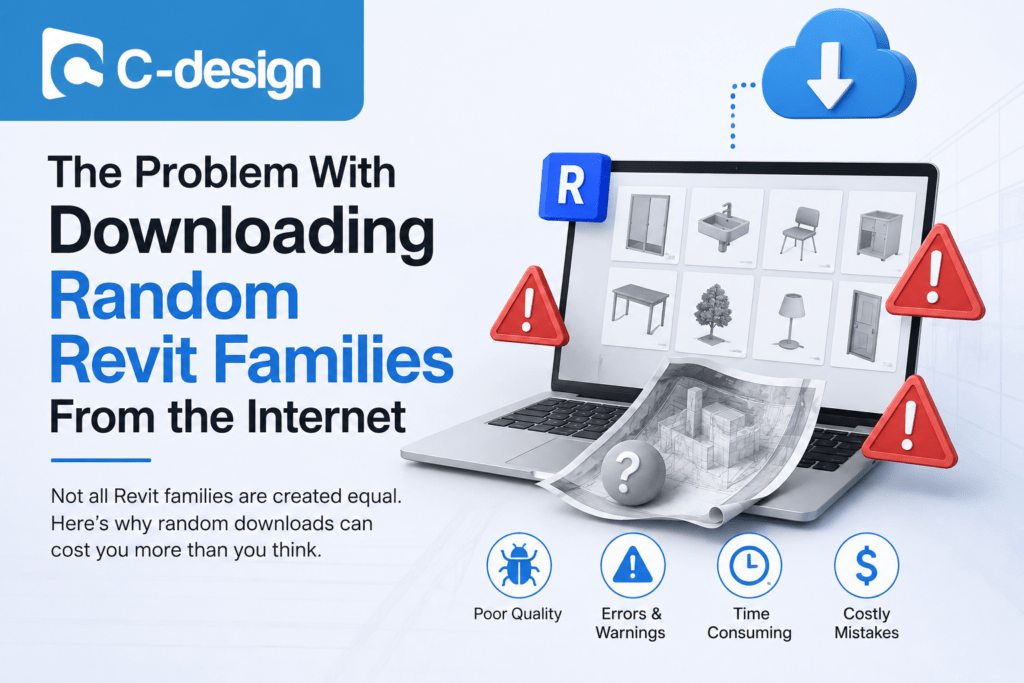
Why Revit families matter
A Revit family is not just a visual object. It can contain geometry, materials, type and instance parameters, formulas, nested families, connectors, visibility settings, annotations, classification data, and manufacturer information. Families can affect what appears in plans, elevations, sections, schedules, tags, and coordination views.
Because families carry information as well as geometry, they play an important role in BIM delivery. A poorly built family can create problems in multiple parts of a project at once. For example, a downloaded door family may look correct in 3D but fail to display properly in plan, use the wrong parameters in schedules, or add unnecessary file weight to every instance placed in the model.
That is why families should be treated as controlled BIM content—not as simple downloadable objects.
Main risks of random families
Free Revit families can be useful starting points, but they may include hidden issues. These are the most common risks teams should understand.
1. Slow and heavy Revit models
One of the most common problems is model performance. Some downloaded families contain excessively detailed geometry, imported CAD files, high polygon-count meshes, large images, duplicate materials, complex arrays, or unnecessary nested components. A single heavy family may not seem like a major issue, but repeated hundreds of times across a project can slow down Revit significantly.
Symptoms may include:
- Longer model opening and saving times
- Slow view navigation and regeneration
- Delays when synchronising central models
- Larger backup files and longer publishing times
- Slower sheet updates and printing
- Greater risk of user frustration and lost productivity
Autodesk guidance recommends removing unused views, families, and other objects through Purge Unused to reduce file size and improve performance. Autodesk family-optimisation material also advises avoiding unnecessarily extensive use of void geometry.autodesk+1
The best approach is to use lightweight, purpose-built families with only the required level of detail for the project stage and view scale.
2. Incorrect or inconsistent parameters
Parameters are central to BIM. They allow teams to tag objects, create schedules, calculate quantities, coordinate disciplines, and exchange structured information. A random downloaded family may use different parameter names, incorrect data types, inconsistent units, or parameters that are not linked to the firm’s shared parameter file.
This can cause:
- Missing information in schedules
- Inconsistent naming across similar elements
- Incorrect quantity takeoffs
- Tags that do not display required information
- Difficulty exporting data to other systems
- Additional manual cleanup before delivery
A family may seem usable until a project manager asks for a door schedule, furniture list, or equipment register. At that point, inconsistent parameters become a serious production problem.
Professional validation should confirm that shared parameters, type and instance settings, formulas, and schedule fields work correctly for the firm’s standards.
3. Wrong categories and subcategories
Revit categories determine how an object behaves in views, schedules, filters, and visibility controls. If a family is assigned to the wrong category, it can create confusion across drawings and models.
For example, a casework family placed in a generic model category may not appear in the correct schedule. A furniture item might ignore the visibility settings applied to the furniture category. An MEP component may lack the correct category or connector configuration for coordination workflows.
Subcategories also matter. They control lineweights, visibility, and graphic standards. A downloaded family with poorly organised subcategories can display inconsistently in plans, elevations, sections, and 3D views.
Before use, teams should verify the family category, subcategories, view representations, and visibility settings against the project’s BIM standards.
4. Unreliable geometry and constraints
A family can appear correct at one size but break when a parameter is changed. This is a common issue with downloaded parametric families. Constraints may be weak, locked incorrectly, or connected to reference planes in a way that fails when the family is flexed.
A door could distort when its width changes. A furniture item could lose geometry when depth is adjusted. An equipment family could display errors when a type is duplicated. These issues can be difficult to find if a team only tests the default family type.
Family testing should include flexing dimensions, changing parameters, duplicating types, testing instance values, and placing the family in several contexts. The family should behave predictably before it becomes part of a standard library.
5. Missing, incorrect, or excessive detail
Downloaded families often have the wrong level of detail for the project. Some are too simple for a detailed construction or coordination package. Others are far too detailed for early design or repeated use throughout a large model.
A high-detail furniture family may include every screw, seam, and decorative feature even though it will only be visible at 1:100 scale. A manufacturer MEP family may include complex internal geometry that provides no value for coordination. Conversely, a low-detail object may not show the clearances, connection points, or information needed for a technical drawing.
The solution is not always more detail. The right solution is the appropriate Level of Detail and Level of Information for the task. Families should support the project stage, view scale, coordination need, and intended data output.
6. Imported CAD, meshes, and dependencies
A downloaded family may contain imported DWG, SAT, OBJ, or mesh content. This can increase file size, introduce unwanted layers or materials, and create geometry that is difficult to control in Revit.
External dependencies can also cause problems. A family might rely on linked files, image paths, nested components, or manufacturer data that does not transfer cleanly to a new project environment.
These hidden dependencies can lead to missing graphics, broken references, model warnings, or inconsistent displays between users. Before using a downloaded family, teams should inspect its imports, nested families, materials, external references, and file size.
7. Incompatible Revit versions
Revit families are generally not backward compatible. A family created in a newer version of Revit cannot be opened directly in an older version. Random downloads may not clearly state the version used to create the file, which can cause immediate access issues.
Before downloading, teams should check:
- The original Revit version
- The project Revit version
- Available types and units
- Whether required external files are included
- Whether the family needs conversion or rebuilding
Official Autodesk content libraries are available by Revit version through Autodesk account downloads, which can be a safer source for baseline content.autodesk
8. Weak scheduling, tagging, and documentation
A family that works in 3D may not work in documentation. It may not show correctly in plan, may have no symbolic lines, may lack suitable annotation, or may not use the parameters required for tagging and scheduling.
This creates extra work for documentation teams. Instead of a family supporting the drawing package, it becomes a manual exception that needs separate fixes on every sheet.
Before approving a family, test it in:
- Plan views
- Elevation views
- Section views
- 3D views
- Different view scales and detail levels
- Relevant schedules
- Tag applications
- Filters and visibility/graphics settings
A standardised family should support the drawings and information outputs that the project requires.
9. Duplicate content and library disorder
When users download content freely, firms often end up with several versions of the same object. One project may use “Chair_01,” another may use “OfficeChair_New,” and another may use a manufacturer object with a different naming structure. Over time, this creates an unmanageable library and inconsistent model data.
Duplicate content causes confusion, increases file size, and makes it harder to maintain standards. It can also create schedule duplicates and inconsistent materials or parameters across projects.
A controlled family library should include approved naming conventions, discipline folders, Revit-version control, manufacturer-content separation, and a process for retiring obsolete families. Guidance for downloaded RFA content similarly advises users to review compatibility, parameters, geometry, nesting, connectors, and file size before loading a family; it also recommends testing files before adding them to a central library.revit-families
10. Copyright and unreliable product data
Not every file available online has clear ownership, current manufacturer information, or dependable technical data. A family could include old specifications, inaccurate dimensions, unlicensed content, or product information that no longer applies.
For generic design content, this may not be critical. But for specification, procurement, construction, or asset-management workflows, unreliable manufacturer data can create serious problems.
Teams should verify product information from the manufacturer where necessary and avoid treating any downloaded family as a fully trusted source of technical or contractual information without validation.
Why validation is essential
The safest approach is to consider every downloaded family unapproved until it has passed a review process. Validation protects performance, data quality, documentation, and project consistency.
A practical validation process should check:
- Revit version compatibility
- Correct family category and subcategories
- File size and geometric complexity
- Imported CAD, meshes, images, and external dependencies
- Visibility settings across different levels of detail
- Parametric behaviour by flexing and changing types
- Type and instance parameter logic
- Shared parameters and naming standards
- Materials and appearance assets
- Symbolic representation in plan and elevation
- Tagging and scheduling functionality
- Nested-family behaviour
- MEP connectors, where relevant
- Model warnings and placement stability
Testing a family in a separate sandbox project is a good practice. It prevents an untested object from affecting a live central model. A Revit-library standardisation guide recommends testing families across plan, elevation, section, 3D, schedules, tags, coordination scenarios, copy operations, and multiple view scales before approval.
When to customise a family
Sometimes a downloaded family is a good starting point but needs adjustment. Customisation can make the family align with the firm’s standards, project information requirements, and documentation methods.
You may need to customise a family when:
- It has the correct basic geometry but wrong parameters
- It needs to use your shared parameter file
- The materials, types, or naming rules do not match your standards
- It does not schedule or tag correctly
- It is too heavy and requires geometry simplification
- It needs different visibility for plan, section, and 3D views
- It needs to support local codes, manufacturer data, or specific project requirements
- It must work as part of a standardised office library
Customisation is often more efficient than rebuilding from scratch, but only if the source family is structurally sound. If a family is severely overbuilt or unstable, rebuilding it as a clean, lightweight, parametric object may be the better choice.
How Outsourcing CAD Works helps
Outsourcing CAD Works supports architects, BIM coordinators, contractors, manufacturers, and design firms that need reliable Revit family content. The team can help create custom families, optimise existing content, validate downloaded files, standardise libraries, and prepare families for project-specific BIM workflows.
Outsourcing CAD Works states that it creates Revit families using component geometry and project-stage-appropriate detail levels, with parameters that may be developed for different delivery stages.outsourcingcadworks
Support can include:
- Custom Revit family creation from drawings, CAD files, product images, or manufacturer data
- Family cleanup and optimisation for improved Revit performance
- Parameter setup, including shared parameters and type/instance logic
- Family flexing and behaviour testing
- Category, subcategory, and visibility configuration
- Schedule and tag compatibility checks
- Standardised naming and library organisation
- Family conversion, rebuilding, or enhancement for client standards
- Lightweight and detailed versions for different project stages
- Quality control before families are placed in production models
This support helps firms avoid the hidden cost of poor BIM content: slow models, unreliable schedules, inconsistent documentation, and extensive rework.
Build an approved family library
The strongest long-term solution is not to stop downloading families completely. It is to build an approved office library. This gives teams fast access to reliable content without introducing random variation into every project.
An approved library should include:
- A clear folder structure by discipline and object type
- Naming conventions that match the firm’s standards
- Version control for Revit releases
- Approved parameters and shared parameter references
- Defined levels of detail for different project stages
- Tested plan, elevation, section, and 3D representation
- Standard material and appearance settings
- Documentation on intended use and known limitations
- Regular audits to remove obsolete or duplicate families
- A formal process for requesting and approving new content
A controlled library speeds up production because users do not have to search the internet for every object. It also protects consistency across projects and reduces repetitive QA effort.
Pre-load checklist
Before loading a free or third-party Revit family into a live project, ask:
- Is the file compatible with our Revit version?
- Is the family from a reliable source, and is the data current?
- Is the category correct for schedules, filters, and visibility controls?
- Is the file size reasonable for its purpose?
- Does it contain unnecessary CAD imports, images, meshes, or nested families?
- Do parameters match our shared parameter and naming standards?
- Does the family flex correctly when sizes and types change?
- Does it display correctly in plan, elevation, section, and 3D views?
- Does it schedule and tag correctly?
- Has it been tested in a sandbox project before use in production?
If the answer to any important question is no, the family should be corrected, customised, or rejected before it enters the live project model.
Long-term value
BIM success depends on trustworthy information. A model filled with poorly managed families may look complete, but it can still be unreliable. Slow performance, inconsistent documentation, inaccurate schedules, and coordination errors all create costs that are often much higher than the time saved by downloading a quick object.
A disciplined family strategy makes projects easier to manage. It improves model performance, reduces coordination problems, supports better documentation, and creates a reusable content foundation for future work.
For firms that work on multiple projects or use Revit across different teams, standardised families are an investment in productivity. They reduce repetitive effort and help every project begin from a stronger technical base.
SEO keywords
Revit families, free Revit families problems, Revit family validation, Revit family creation services, Revit family optimization, Revit BIM standards, custom Revit families, Revit family library, BIM content management, Revit model performance, Revit family parameters, Outsourcing CAD Works.
FAQs
1. Are free Revit families safe to use in production projects?
Some free families can be useful, but they should not be loaded directly into a production model without validation. Teams should check version compatibility, file size, geometry, parameters, schedules, tags, visibility, and data accuracy first.
2. Why can downloaded Revit families slow down a project model?
Downloaded families may contain overly detailed geometry, imported CAD files, meshes, large images, duplicate materials, or unnecessary nested components. When placed many times, these elements can increase file size and reduce Revit performance.
3. What should be checked before loading a Revit family?
Check the Revit version, family category, file size, geometry, parameters, shared parameters, materials, nested families, visibility settings, parameter flexibility, schedule and tag behaviour, and any required MEP connectors.
4. What is Revit family optimisation?
Revit family optimisation is the process of simplifying unnecessary geometry, reducing file weight, improving parameter logic, removing unwanted imports, and ensuring a family performs efficiently in a project model.
5. Why are shared parameters important in Revit families?
Shared parameters allow data to be used consistently across families, tags, and schedules. Without standardised parameters, firms may experience missing data, inconsistent schedules, and extra manual work.
6. Can a downloaded Revit family be customised?
Yes. A downloaded family can often be edited to add the correct parameters, improve visibility, simplify geometry, update materials, and match a firm’s documentation or BIM standards. In some cases, rebuilding the family is more efficient.
7. How does Outsourcing CAD Works help with Revit families?
Outsourcing CAD Works helps firms create custom Revit families, validate and optimise downloaded content, configure parameters, support scheduling and tagging, organise family libraries, and establish quality-focused BIM-content workflows.
Call to action
Do not let an untested Revit family create hidden problems in your BIM model. Outsourcing CAD Works can help you validate, optimise, customise, and standardise Revit families for accurate documentation, faster model performance, reliable schedules, and smoother coordination.
Whether you need a single custom family, a complete manufacturer library, family cleanup, or an approved office content standard, our BIM professionals can support your workflow.
Visit Outsourcing CAD Works to discuss your Revit family creation and BIM-content requirements.
Tags

No comments:
Post a Comment