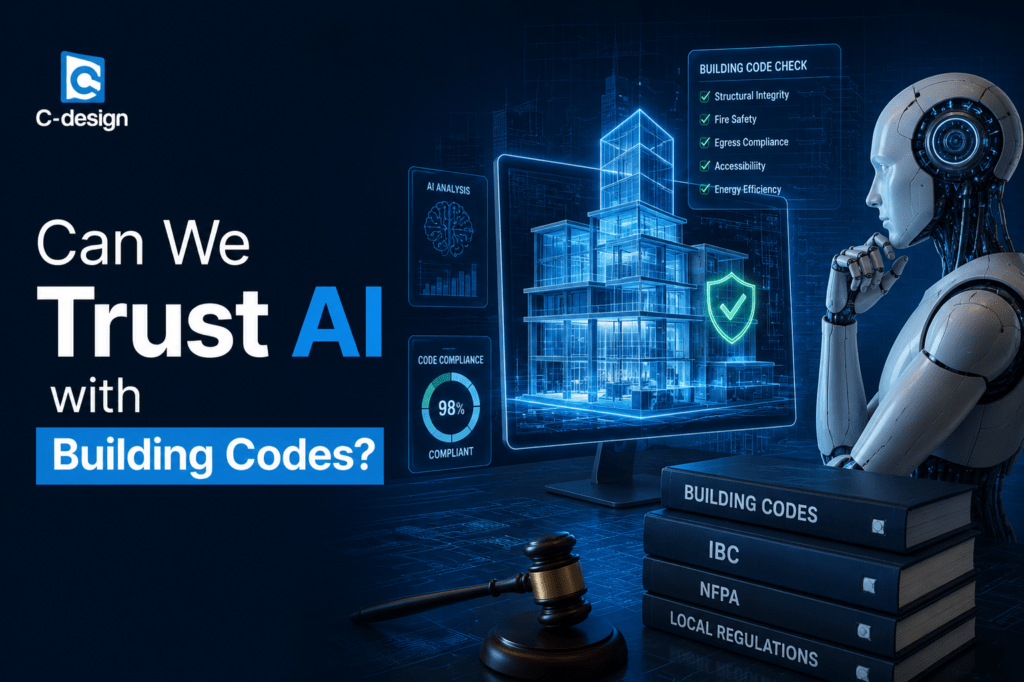
Can We Trust AI with Building Codes?
Why Smart CAD Outsourcing Is the Safer Bet for Code Compliance
By Outsourcing CAD Works | www.outsourcingcadworks.com
Artificial intelligence has quietly worked its way into almost every corner of the architecture, engineering, and construction (AEC) industry — from generative design tools to automated clash detection. Now it's knocking on the door of one of the most sensitive parts of the building process: code compliance. Software vendors are promising instant building code checks, automated permit reviews, and AI-generated compliance reports that supposedly eliminate the need for tedious manual verification.
It sounds appealing. But the question every architect, structural engineer, developer, and contractor should be asking is simple: can we actually trust AI with building codes, or is this a shortcut that trades long-term safety for short-term speed?
In this article, we'll break down what AI can and can't do when it comes to building code compliance, where the real risks lie, and why a hybrid approach — AI-assisted, human-verified CAD drafting — is quickly becoming the industry's preferred way forward. We'll also look at how Outsourcing CAD Works helps architecture and engineering firms get the best of both worlds: the speed of automation and the accountability of experienced drafting professionals.
This isn't just a technology debate, either. Building codes exist to protect lives — they govern fire egress widths, structural load paths, accessibility clearances, seismic resilience, and dozens of other life-safety factors. A missed clause is rarely just a minor inconvenience; it can mean a failed inspection, an expensive redesign, or in the worst case, a genuinely unsafe building. That's why the question of trusting AI with building codes deserves more nuance than a simple yes-or-no answer.
Understanding AI in Building Code Compliance
Before deciding whether AI can be trusted with building codes, it helps to understand what "AI-driven building code compliance" actually involves. Most tools in this category use machine learning and natural language processing to:
- Scan architectural and structural drawings for code violations (setbacks, egress width, fire ratings, accessibility clearances, etc.)
- Cross-reference local, state, and international building codes against a submitted design
- Flag potential non-compliance issues before a project reaches a human plan reviewer
- Generate automated compliance checklists or pre-submission reports
These systems are often built on Building Information Modeling (BIM) data, meaning the AI is only as good as the model it's reading. This is the first crack in the "fully trust AI" argument — and it's an important one for any firm relying on outsourced CAD drafting services or in-house teams alike.
The Real Advantages of AI in Building Code Checking
To be fair, AI brings genuine value to the code-compliance process, and dismissing it outright would be a mistake. Here's where it earns its keep:
1. Speed at Scale
AI can scan hundreds of pages of drawings and specifications in minutes, something that would take a human reviewer days. For large multi-building developments, this speed is a real competitive advantage.
2. Consistency in Repetitive Checks
Rule-based checks — like minimum stair width, door swing clearances, or parking ratio calculations — are exactly the kind of repetitive, rules-driven tasks where AI performs reliably.
3. Early Error Detection
Catching an obvious code violation early, before drawings go to a plan reviewer or client, saves time, reduces revision cycles, and lowers project costs.
4. Searchable Code Libraries
AI-powered platforms can instantly pull the relevant clause from the IBC, NBC, Eurocode, or local amendment, saving drafters and engineers from digging through hundreds of pages of regulation manually.
Where AI Falls Short — And Why It Matters
Despite these strengths, AI's limitations in building code compliance are significant, and they are exactly the kind of gaps that can turn into safety hazards, failed inspections, or costly legal exposure.
1. Building Codes Are Full of Judgment Calls
Codes are not purely mathematical. Terms like "reasonable access," "equivalent protection," or "approved by the authority having jurisdiction" require human interpretation. AI struggles with this kind of context-dependent reasoning, especially when local amendments override national codes.
2. Local Amendments Change Constantly
Building codes are not static. Cities and counties frequently issue amendments, variances, and interim rulings. An AI model trained on outdated code data will confidently produce wrong answers — and it often won't know it's wrong.
3. Garbage In, Garbage Out
AI compliance tools depend entirely on the accuracy of the CAD or BIM model fed into them. If the underlying drawing has an error, a missing dimension, or an incorrect layer, the AI's compliance report inherits that error without flagging it.
4. No Accountability or Liability
If an AI tool misses a fire-rating requirement and a building fails inspection — or worse, fails structurally — who is responsible? Software vendors typically disclaim liability entirely, leaving architects, engineers, and owners exposed.
5. Complex, Multi-Discipline Conflicts
Real projects involve overlapping systems — structural, mechanical, electrical, plumbing, and fire protection — all interacting inside the same building envelope. AI is still catching up on reasoning across these interconnected systems the way an experienced drafter or engineer naturally does.
A Quick Checklist Before You Trust an AI Compliance Tool
If your firm is evaluating an AI-based code-checking platform, it's worth pausing before you rely on it for anything client-facing or submission-critical. Ask these questions first:
- How often is the underlying code database updated, and does it include local amendments for your specific jurisdiction?
- Does the vendor publish accuracy rates, and are those rates verified by an independent third party?
- What happens when the tool encounters a condition it wasn't trained on — does it flag uncertainty, or does it guess silently?
- Who is contractually liable if the tool misses a violation that leads to a failed inspection or rework?
- Can the tool explain why it flagged (or didn't flag) an issue, so a human reviewer can verify the logic?
- Does the platform integrate with your existing CAD or BIM workflow, or does it require rebuilding your models in a proprietary format?
If a vendor can't answer these questions clearly, that's a strong signal the tool should be treated as a helpful assistant, not a final authority. This is precisely the gap that a knowledgeable outsourced drafting partner is built to fill.
AI-Only vs. In-House vs. Outsourced CAD: A Practical Comparison
Firms generally choose between three approaches to handle code-compliant drafting and documentation. Here's how they stack up in practice:
AI-Only Compliance Checking
Fast and inexpensive for high-volume, repetitive checks, but it carries real risk on nuanced conditions, local amendments, and multi-discipline conflicts. Best used as a first-pass filter, never as the final word on compliance.
Fully In-House Drafting Teams
Offers direct oversight and institutional knowledge, but is expensive to staff, slow to scale during busy periods, and often lacks bandwidth to keep up with every regional code update on top of daily production work.
Outsourced CAD Drafting with Human + AI Review
Combines the speed of automation with dedicated, code-aware drafting professionals who verify every deliverable. It scales instantly with project volume, costs less than maintaining an equivalent in-house team, and adds a layer of accountability that AI-only tools simply can't offer. This is the model Outsourcing CAD Works follows for every project we take on.
So, Can We Trust AI With Building Codes?
The honest answer is: partially, and only with human oversight. AI is an excellent first-pass filter — a tireless assistant that catches obvious errors and speeds up repetitive checks. But it is not, and should not be treated as, the final authority on code compliance.
The firms getting the best results are not choosing between AI and human expertise. They're combining both: using AI to accelerate the first 80% of compliance checking, then relying on experienced CAD drafters and engineers to verify the nuanced, judgment-heavy 20% that actually determines whether a project passes inspection.
This hybrid model is exactly where outsourced CAD drafting partners provide the most value — and it's the model Outsourcing CAD Works has built its entire service around.
How Outsourcing CAD Works Delivers Flawless, Code-Compliant CAD & BIM Solutions
Navigating the complex landscape of AI code auditing and international building standards requires dedicated expertise, robust quality control systems, and flexible drafting capacity. This is precisely where Outsourcing CAD Works (www.outsourcingcadworks.com) provides an unmatched competitive advantage for architectural firms, engineering consultancies, and construction companies worldwide.
Who We Are
Outsourcing CAD Works (www.outsourcingcadworks.com) is a premier global provider of high-precision Computer-Aided Design (CAD) drafting, Building Information Modeling (BIM), structural drafting, and architectural documentation services. With years of hands-on experience serving clients across North America, Europe, the United Kingdom, Australia, and the Middle East, we bridge the gap between advanced technology and human precision.
Why Choose Outsourcing CAD Works for Code-Compliant Drafting?
- 1. The Human-in-the-Loop Advantage: Our team integrates advanced AI-driven spatial checking tools with rigorous, multi-tiered human quality assurance (QA). Every drawing produced or updated by our team undergoes a stringent 3-point compliance check executed by senior architectural and engineering drafters.
- 2. Deep International Code Familiarity: Building regulations vary significantly by country and municipality. Our CAD professionals possess deep expertise in major international building codes, including the International Building Code (IBC), Americans with Disabilities Act (ADA), NFPA Life Safety, UK Building Regulations (Approved Documents), Australian National Construction Code (NCC), and Gulf Region (UAE/Saudi) Fire & Life Safety Codes.
- 3. Significant Cost Optimization: Maintaining an in-house drafting team dedicated to code research and compliance checks creates heavy fixed overheads. By partnering with Outsourcing CAD Works, AEC firms save up to 60% on drafting costs while securing elite-level compliance expertise on-demand.
- 4. Accelerated Permit Approval & Zero Re-Work: Permit delays can ruin project profitability. Our streamlined workflows, automated QA checks, and global delivery centers allow us to deliver fully compliant, permit-ready construction documentation with rapid turnaround times, helping you secure municipal approval on the first submittal.
- 5. Scalable CAD & BIM Solutions: Whether you need 2D CAD drafting, 3D Revit BIM modeling, MEP coordination, structural shop drawings, or comprehensive permit drawings, we seamlessly scale our drafting team to support your firm’s workload without compromise.
Outsourcing CAD Works Service Matrix & Compliance Safeguards
| Service Category | Key Deliverables | Compliance & Quality Safeguards |
| Architectural Drafting & Permit Drawings | 2D Floor Plans, Elevations, Sections, Site Plans, Reflected Ceiling Plans. | Full IBC/ADA/UK Regs check; egress clearance verification; fire door & partition scheduling. |
| BIM Modeling & Clash Detection | Autodesk Revit 3D Models, LOD 100 to LOD 500, Solibri Clash Audits. | Rigorous element parameter tagging; spatial conflict resolution; automated rule-set verification. |
| Structural & MEP Coordination | Structural framing plans, rebar detailing, HVAC/Plumbing/Electrical layouts. | Code-compliant structural clearance verification; pipe/duct penetration fire-stop detailing. |
| As-Built & Retrofit Conversions | Point cloud to CAD/BIM conversion, historical renovation drafting. | Existing vs. proposed code compliance mapping; adaptive reuse accessibility validation. |
Why Outsourcing CAD Works Is the Smarter Way to Handle Code Compliance
At Outsourcing CAD Works, we don't see AI as a replacement for skilled drafters and engineers — we see it as a tool that, in the right hands, makes our human experts faster and more accurate. Here's how that translates into real advantages for architecture, engineering, and construction firms who work with us:
1. Human-Verified, Code-Compliant Drawings
Every CAD and BIM deliverable that leaves our studio is checked by experienced drafters who understand regional building codes, zoning bylaws, and accessibility standards — not just what a rules engine flags, but what a real plan reviewer will actually look for.
2. Local Code Expertise Across Regions
Our teams work across projects governed by the IBC, IRC, NBC, Eurocode, and various state and municipal amendments. This breadth of experience means we understand how local jurisdictions interpret and enforce code — something generic AI compliance tools frequently miss.
3. Faster Turnaround Without Cutting Corners
By using AI-assisted tools for the repetitive, rules-based portions of a code check, our drafters spend their time where it counts most — reviewing complex conditions, multi-discipline conflicts, and edge cases that automated systems routinely overlook.
4. Reduced Revision Cycles and Rejection Risk
Because our drawings are reviewed for code compliance before they ever reach a permitting authority, clients see fewer plan-check rejections, fewer costly redesigns, and faster project approvals.
5. Scalable Support for Firms of Any Size
Whether you're a small architecture practice needing overflow drafting support or a large firm managing multiple concurrent developments, our outsourced CAD services scale up or down without you having to hire, train, or manage an in-house drafting team.
6. Cost-Effective Quality Control
Outsourcing your CAD and code-compliance drafting to a dedicated team costs a fraction of maintaining that expertise in-house, while still delivering senior-level review on every set of drawings
.
7. A True Partner, Not Just a Vendor
We work as an extension of your team — communicating directly with your architects and engineers, incorporating jurisdiction-specific feedback, and adapting quickly as codes and project requirements change.
CAD & Compliance Services We Offer
- Architectural CAD drafting and 2D/3D documentation
- Structural drafting and detailing
- BIM modeling and coordination (Revit, AutoCAD, and more)
- Construction documentation and permit-set preparation
- Code compliance review and pre-submission quality checks
- MEP drafting coordination for multi-discipline projects
- As-built drawings and redlining services
Each of these services is delivered with a quality-control process designed to catch what automated tools miss, so your projects move through permitting and inspection with far fewer surprises.
Where Is AI in Building Codes Headed Next?
AI's role in code compliance will keep expanding, and that's a good thing for the industry overall. Future tools are likely to get better at parsing local amendments, cross-referencing multiple code bodies simultaneously, and even suggesting design alternatives that resolve a flagged violation automatically.
But even as these tools improve, the fundamental relationship between technology and human oversight isn't likely to disappear. Building departments, insurers, and licensing boards will continue to require a qualified professional to stamp, sign, and take responsibility for a set of drawings. That accountability structure is unlikely to be handed over to software any time soon — and it shouldn't be.
For architecture and engineering firms, the practical takeaway is this: adopt AI tools where they genuinely save time, but build your workflow around a trusted drafting partner who understands both the technology and the code. That combination is what keeps projects moving quickly without gambling on safety or approval.
Conclusion
Artificial Intelligence is undeniably revolutionizing the Architecture, Engineering, and Construction industries, offering unprecedented speed and computational audit capabilities. However, when human lives, structural integrity, and multi-million-dollar investments are at stake, trusting AI blindly with building codes is a risk no firm can afford to take.
The future of successful AEC project delivery lies in a balanced, intelligent synergy: leveraging AI for automated, high-speed spatial diagnostics while entrusting final verification and precise documentation to seasoned CAD and BIM specialists.
| PARTNER WITH THE EXPERTS: Don't leave your building code compliance to chance or unverified algorithms. Ensure 100% permit compliance, zero rework, and maximum cost efficiency for your architectural and engineering projects. |
Ready to elevate your CAD drafting and BIM workflows? Contact Outsourcing CAD Works today at www.outsourcingcadworks.com to request a free project quote or schedule a consultation with our BIM and CAD compliance specialists.
Ready to Build with Confidence?
Don't leave code compliance to chance. Partner with Outsourcing CAD Works for accurate, human-reviewed CAD drafting and BIM services that keep your projects on schedule and inspection-ready.
Visit www.outsourcingcadworks.com today to request a free quote and see how our drafting team can support your next project.
Frequently Asked Questions
Q: Can AI fully replace human building code reviewers?
A: No. AI can speed up repetitive, rules-based checks, but it still struggles with judgment calls, local amendments, and multi-discipline conflicts that require human expertise.
Q: What are the biggest risks of relying only on AI for code compliance?
A: The main risks are outdated code data, misreading local amendments, missing multi-system conflicts, and a lack of accountability if the AI makes an error that leads to a failed inspection.
Q: Does Outsourcing CAD Works use AI tools in its drafting process?
A: Yes, we use AI-assisted tools to speed up repetitive checks and documentation, but every deliverable is reviewed and verified by experienced human drafters before it reaches the client.
Q: Which building codes does Outsourcing CAD Works have experience with?
A: Our teams have experience with the IBC, IRC, NBC, Eurocode, and a wide range of state, provincial, and municipal amendments across multiple countries.
Q: How does outsourcing CAD drafting reduce permit rejection risk?
A: By having experienced drafters review drawings for code compliance before submission, common errors and omissions are caught early, reducing the chance of rejection or costly resubmissions.
Q: Is outsourcing CAD drafting cost-effective for small architecture firms?
A: Yes. Outsourcing gives small firms access to senior-level drafting and code expertise without the overhead of hiring and training an in-house team.
Q: How quickly can Outsourcing CAD Works turn around a project?
A: Turnaround time depends on project scope and complexity, but our combination of AI-assisted workflows and dedicated drafting teams allows us to deliver significantly faster than traditional in-house-only processes.
Tags:
#AIinConstruction #BuildingCodes #CADOutsourcing #BIMServices #ArchitecturalDrafting #StructuralDrafting #ConstructionCompliance #CodeCompliance #OutsourcingCADWorks #ConstructionTechnology #AECIndustry #PermitDrawings
Primary Keywords :
AI and building codes, AI building code compliance, CAD outsourcing services, building code compliance software, AI in construction industry, outsourced CAD drafting, architectural CAD services, structural drafting services, BIM outsourcing, construction documentation services.

No comments:
Post a Comment